

Nairobi National Park is a national park in Kenya that was established in 1946, about 7 km (4.3 mi) south of Nairobi. It is fenced on three sides, while the open southern boundary allows migrating wildlife to move between the park and the adjacent Kitengela plains. Nairobi National Park is well known as a rhinoceros sanctuary and is an important conservation area for black rhinos.
Nairobi National Park Black Rhinos
Nairobi National Park is one of the best places to observe the Eastern browse (black) rhino (Diceros bicornis michaeli) in the wild. These intelligent and fascinating creatures have inhabited the Earth for millions of years. Nairobi National Park is one of Kenya’s successful rhinoceros sanctuaries and one of the few parks where visitors have a strong chance of seeing a black rhino in its natural habitat.
Black rhinos are highly intelligent creatures that have inhabited the Earth for millions of years. Today, the species is perilously close to extinction, and the rate of its decline has been truly astounding, including in Nairobi National Park.
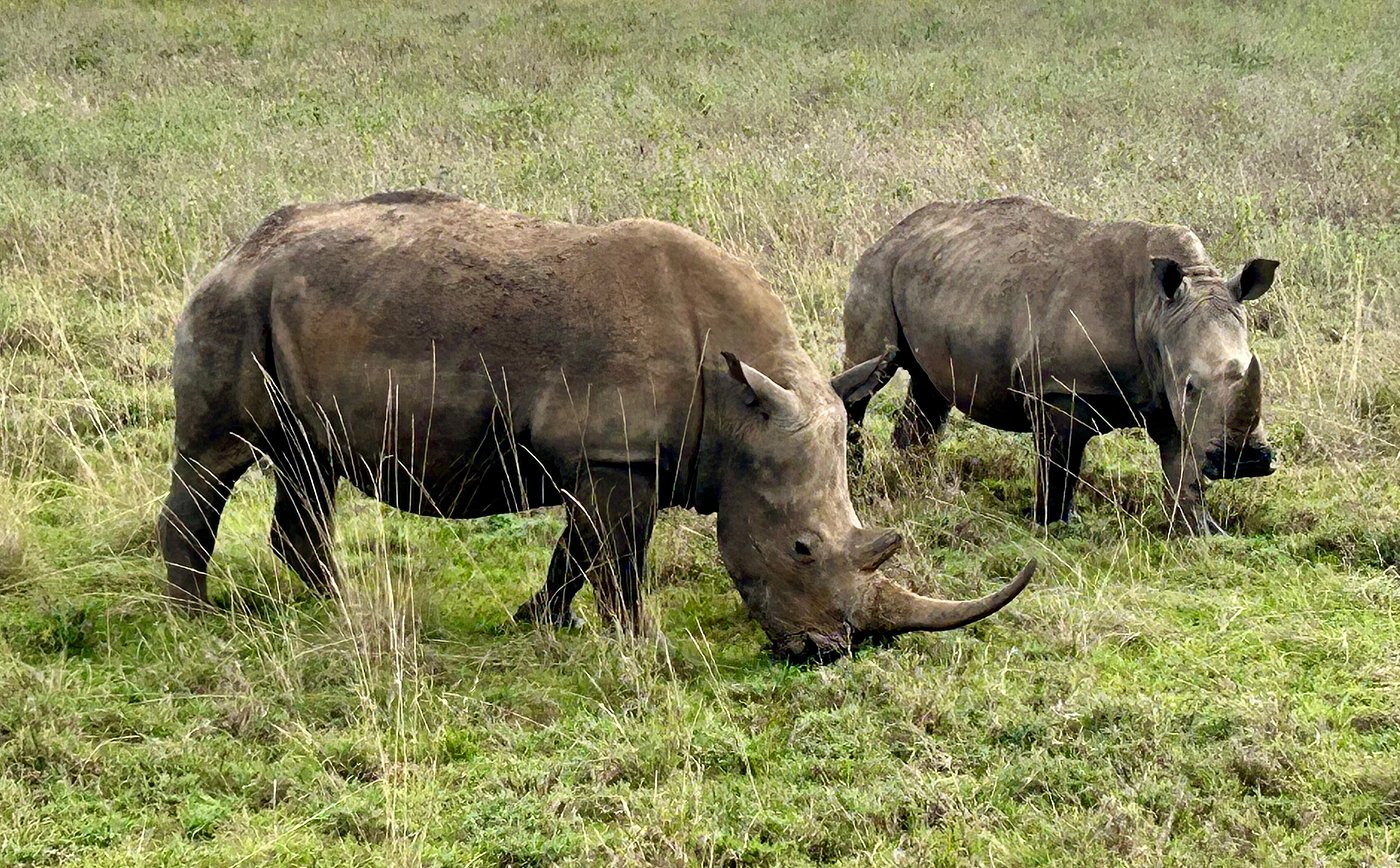 They are among the largest land animals, with the elephant being the largest. Black rhinos have a robust, cylindrical body with a large head, relatively short legs, and a short tail. A characteristic feature of the black rhino is its large horn in the middle of the face, although some individuals have a second, smaller horn. Black rhinos are mammals belonging to the class Mammalia, characterized by the presence of mammary glands, which in females produce milk for feeding their young.
The open savannah landscape of Nairobi National Park enables visitors to spot and observe these impressive pachyderms in their natural habitat. Nairobi National Park provides a convenient opportunity to observe Eastern black rhinos, whose population was severely affected by poaching during the 1970s. Nairobi National Park is home to black rhinos, as well as southern white rhinos that have been translocated here for their protection amid rhino poaching threats.
Silole Cottage provides accommodation for those wanting to get close to rhinos, while at the Silole Sanctuary, visitors can participate in rhino tracking and learn about the ways and reasons behind rhino behavior on foot.
Black rhinos are important because they are referred to as an umbrella species. Like an umbrella protects you from the rain, conservation of an umbrella species can indirectly protect many other species. Because there are millions of species of conservation concern and resources available for conservation are limited, umbrella species can be useful when making conservation decisions. In this way, when you save a rhino, you also help protect an ecosystem.
In Nairobi National Park, the black rhino is usually solitary, while the white rhino tends to be more social. The black rhino is a browser, and its triangular-shaped upper lip, which ends in a grasping point, is used to eat a large variety of vegetation, including leaves, fruits, buds, and shoots of plants, bushes, and trees. Black rhinos can be found in various habitats with woody vegetation.
Nairobi National Park is an important rhino sanctuary, forming a nucleus for supporting other rhino populations. The park has played an important role in conservation, where Kenya Wildlife Services have used rhino conservation efforts to help restore populations in other areas.
Black Rhino Behavior and Reproduction

Male rhinos are territorial. When they grow and reach a certain age, they start forming their own territories to guard their resources. This can lead to fights, which are a common occurrence, with stronger individuals displacing less fit ones. Black rhino fights can indicate that the carrying capacity has been exceeded and that management should take action.
Male black rhinos need to wait until they are about 10 to 12 years old before they can claim a territory and mate. Black rhinos may reach 40 to 50 years of age, while females reach sexual maturity between the ages of 4 and 7. Gestation lasts approximately 14 to 16 months, with a single calf being the norm every 2½ to 3 years.
Black rhinos do not avoid fights, but they use their horns to defend themselves. Their horns are sharp enough to cause serious injuries, while rubbing the horns against rough surfaces removes the soft outer layer.
Black rhinos weigh between 1,000 and 1,800 kilograms (2,200 to 3,970 lbs). Their body length ranges from approximately 2.9 to 3.75 meters, while their tail length is between 60 and 70 cm and their shoulder height is about 1.4 to 1.8 meters.
Black rhinos also have a defense mechanism that involves soaking in mud or rolling in dust, which helps protect them against sunburn and insect bites. Because rhinos have poor eyesight, they may charge when startled. In the wild, rhinos have been observed charging at boulders or trees. This behavior has contributed to their undeserved reputation for having a bad temper.
How Black Rhinos Communicate
Black rhinos communicate through honks, sneezes, and dung. During confrontations, they growl and make trumpet calls. Black rhinos snort when they are angry, make sneeze-like calls as alarms, scream when they are scared, and make a “mmwonk” sound when relaxed. Rhinos also communicate through their dung and urine.
Black rhinos have special adaptations that help them survive. First, they have an excellent sense of smell, which allows them to detect anything getting too close. Secondly, to compensate for their poor eyesight, they have excellent hearing, with ears that can rotate to take in sounds from different directions.
Black Rhinos as Browsers
Black rhinos are unique because they are browsers rather than grazers. Their pointed upper lip helps them feed on leaves from bushes and trees. During your safari to Nairobi National Park, black rhinos are among the outstanding creatures you should look forward to seeing.
A safari in Kenya provides an opportunity to see these remarkable animals in their natural habitat and experience the wildlife and conservation importance of Nairobi National Park.